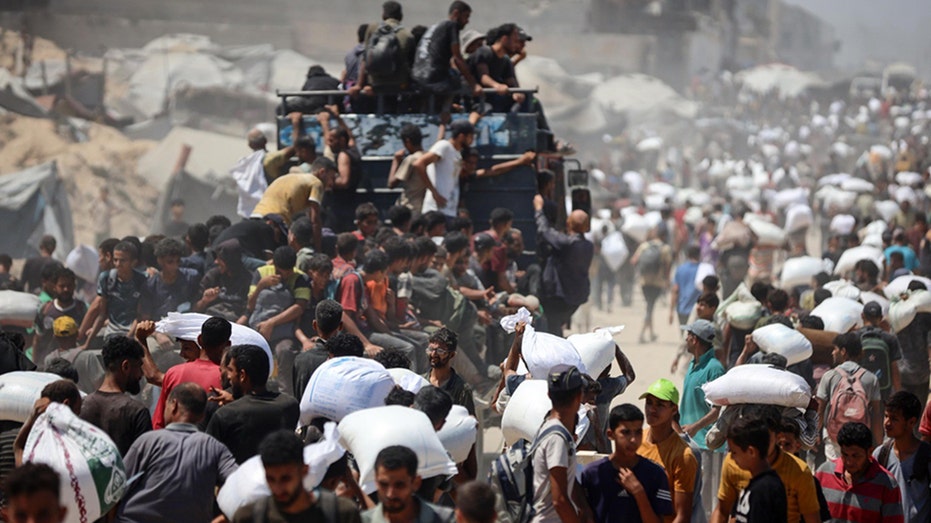
The Trump State Department has reacted to a new report by UNICEF on malnutrition in Gaza by saying it "completely shatters" the allegations that Israel deliberately starved civilians in the Hamas-run enclave.
The outcry of criticism comes as a report used by the United Nations and quoted by much of the world's media projected starvation in Gaza well into June.
Following Hamas’ invasion of southern Israel on Oct. 7, 2023, that led to the deaths of some 1,200 people and the kidnapping of 251 Israeli and foreign nationals, the Jewish state invaded Gaza, which led to accusations of genocide and deliberate starvation tactics used against Gazans.
The UNICEF-led National Nutrition Cluster report from last month was able to reach 1,335 children under age 5 throughout 83% of the Gaza Strip to assess its risk of malnutrition. Malnutrition rates were determined by weight-for-height Z-score (WHZ) and mid-upper-arm circumference (MUAC). Using WHZ figures, rates ranged from 0.2% in Khan Younis and Rafah to 0.8% in Gaza City. MUAC measurements found malnutrition rates ranging from 1.5% in Gaza City to 1.9% in Deir Al-Balah.
About 17% of the population could not be surveyed due to security and operational constraints.
TRUMP ADMINISTRATION PROBES UNRWA OVER ALLEGED EMPLOYMENT OF 1,500 TERRORISTS
A State Department spokesperson told Fox News Digital that "UNICEF’s latest findings demonstrate another example that completely shatters the countless false allegations against Israel of deliberate starvation of civilians in Gaza. There are U.N. entities, media outlets and NGOs that should retract and correct their politicized and baseless attacks on Israel – which has provided an unprecedented over 2 million tons of food into Gaza since the ceasefire."
The rates of malnutrition UNICEF documented are on par with, or substantially lower than, those in some neighboring countries. According to a post on X from the Israeli Coordinator of Government Activities in the Territories (COGAT), acute malnutrition figures in the region range from 1.3% in Gaza, Lebanon, and Turkey to 2.3% in Jordan, 3.3% in Egypt, 12.2% in Syria and 17.7% in Sudan.
UNICEF’s report has raised ire from onlookers who took issue with the Integrated Food Security Phase Classification (IPC) statement that famine was "confirmed" in Gaza in August 2025.
The catalyst for the uproar was the IPC's warning from August 2025 that famine had reached Gaza Governorate. At that time, the IPC estimated that "through June 2026, at least 132,000 children under 5 are expected to suffer from acute malnutrition," including 41,000 severe cases where children would be "at heightened risk of death."
The IPC is expected to release a full report on conditions in Gaza "in the coming days." Prior to releasing the report, they have assessed that the Gaza Strip would be in Phase 2, the "alert" phase for malnutrition, between July and December 2026. They state that "74,200 children aged 6–59 months will likely require treatment for acute malnutrition through April 2027, with more than 11,400 severe cases expected."
UNICEF’s July report found that "very few confirmed nutrition-related deaths have been reported during treatment" in Gaza. The IPC did not respond to questions about UNICEF’s findings or whether they stood by their prior claims that famine had been reached in Gaza.
HAMAS AGREES TO COMPLETE DISARMAMENT UNDER 'HISTORIC' GAZA AGREEMENT: TRUMP
The State Department spokesperson added that "the United States, in coordination with Israel, have facilitated humanitarian assistance while taking important steps to prevent Hamas from diverting or looting the aid, providing more support to Gazans. The president has a bold and ambitious plan to rebuild Gaza, which is well underway through the efforts of the Board of Peace to facilitate disarming Hamas and ensure it is no longer a threat to Israel."
Andrew Fox, a senior fellow at the Henry Jackson Society who has closely studied the Gaza conflict, told Fox News Digital that "the new data shows that the allegations of famine in Gaza were pure hysteria." He said that while "certain small pockets of hunger occurred in Gaza, we now know this can only have been an issue of distribution. Once again, international organizations removed Hamas and their share of the blame for Gaza’s suffering from the conversation, stoking the anti-Israel narrative."
Prof. Aron Troen, director of the Nutrition and Brain Health Laboratory who teaches in the School of Nutrition Science and the School of Public Health at The Hebrew University in Jerusalem, told Fox News Digital that the UNICEF findings are "very, very good news." He said it was "remarkable that in an area which was very recently claimed to be experiencing not only famine, but a deliberate and imposed political famine, that the situation has gone to the point that the current measures, and at least some of them, right now are better than…other places in the Arab world."
CHRISTIAN LEADERS HOLD EMERGENCY SUMMIT IN JERUSALEM TO CONFRONT GLOBAL RISE IN ANTISEMITISM
"It’s important to state that if one wishes to take seriously the efforts to identify humanitarian need and provide an adequate response, then you have to be just as open to the good news as to the bad news," Troen said. He further decried "narratives" surrounding the report "that serve political agendas." He said that if there were the possibility of "a gradual transfer of pragmatic agency to a Palestinian governance in the interests of two states, respect for borders, coexistence," that it "requires people to stop throwing around genocide, famine, and impugning one side or the other in order to gain political leverage."
Kurtis Cooper, Chief of Global Media at UNICEF, told Fox News Digital that "the recent nutrition survey measures conditions in mid-2026, more than nine months after the IPC confirmed famine in August 2025 and after a ceasefire and substantial scale-up in humanitarian assistance. It does not tell us what conditions were in August 2025, and it was never designed to."
Cooper said that "in terms of why the situation has improved, during the period covered by the August 2025 IPC analysis, programmes to detect and treat malnutrition were largely operating, but blanket supplementary feeding had largely ceased across Gaza because of severe access constraints and supply disruptions. Programme data show a similar trend: admissions for treatment of acute malnutrition peaked at nearly 17,000 children in August 2025 before falling to around 3,100 by May 2026."
Cooper did not answer questions about how WHZ rates measured in Gaza compare to those in other countries experiencing widespread human suffering.
In May, UNICEF reported that in Sudan, "almost 100,000 children were admitted for treatment for severe acute malnutrition" between January and March. UNICEF estimated that 825,000 children under 5 would experience severe acute malnutrition in Sudan in 2026.
Andrew Fox called on "leading organizations" to "offer a public and full retraction of their error-strewn papers." He explained that "their mistakes have paved the way for an explosion in global antisemitism, and these organizations must own their roles in that and make amends as loudly as possible."
According to the J7 Large Communities’ Task Force Against Antisemitism, 2025 was the deadliest year for antisemitic attacks around the world since 1994.