Samsung remains the world's biggest memory chipmaker for good reason. The company continuously develops cutting-edge technologies to push the performance and efficiency of its silicon. Now, Samsung has unveiled a compact, ultra-dense 256TB SSD designed specifically for data centers.
During the Global Memory Innovation Forum 2026 in Shenzhen, China, Samsung Semiconductor introduced two next-generation enterprise drives: the BM1773 and the PM1763.
BM1773 SSD: High-capacity storage for data center servers
The BM1773 is an ultra-high-density QLC SSD available in capacities reaching up to an impressive 256TB, all packaged within the compact E3.S form factor.
Under the hood, the BM1773 leverages Samsung's 9th-generation high-density NAND flash (V9Q 2Tb) running across a 16-channel PCIe 5.0 architecture. It delivers sequential read speeds of up to 4.5GB/s and random write speeds of up to 50K IOPS. Compared to previous-generation QLC drives, the new SSD doubles total bytes written (TBW) endurance and is rated for 0.6 drive writes per day (DWPD).
It also features an intelligent die-failure recovery mechanism. If a single memory die fails, the drive continues operating normally rather than dropping the entire SSD into a restrictive read-only state. Security and compliance features include CNSA 2.0 support and FIPS sub-chip certification.
PM1763 SSD: Built for high-performance enterprise workloads
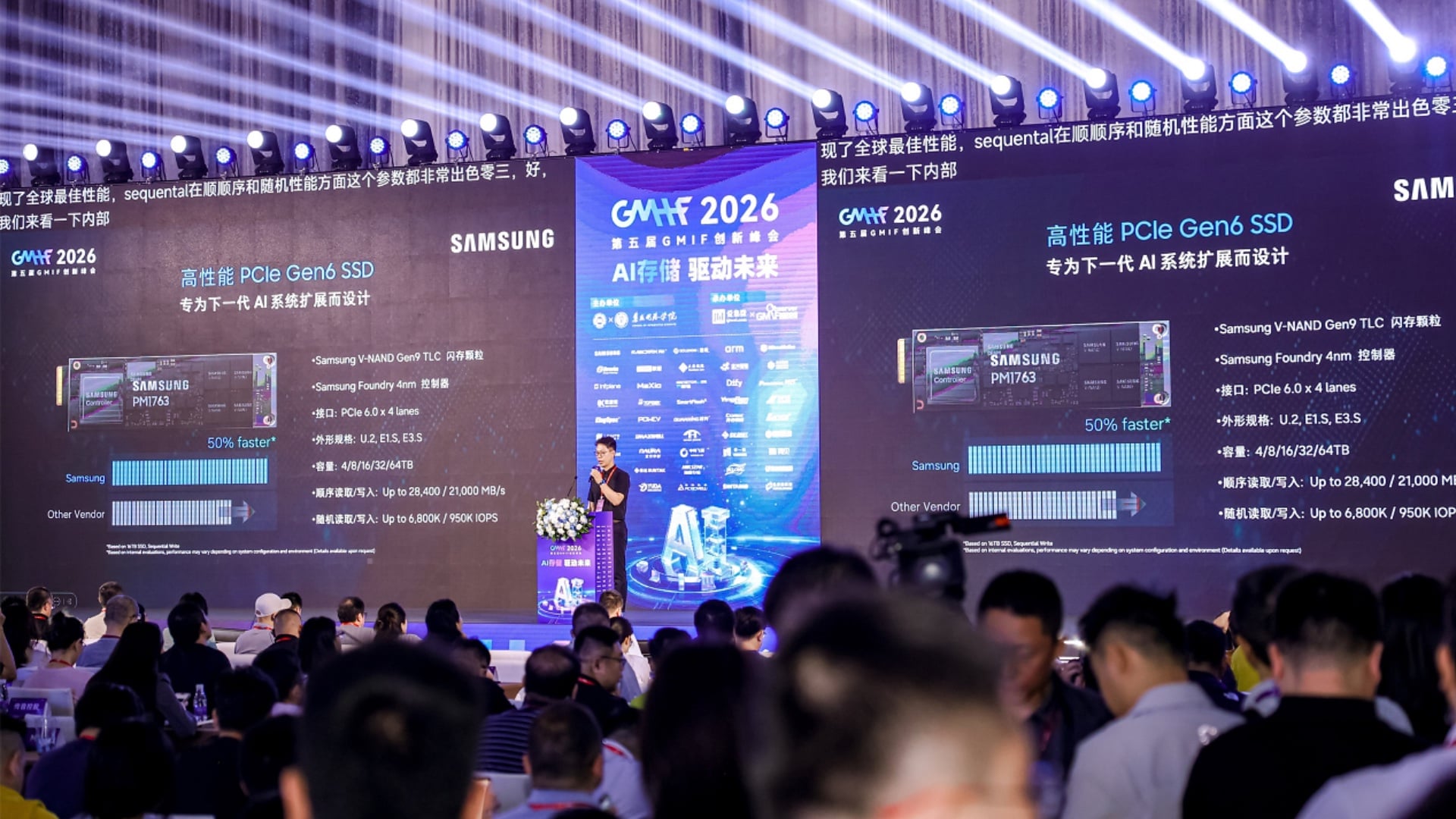
Samsung showcasing PM1763 SSD at the GMIF Innovation Summit 2026 in Shenzhen, China | Source: Samsung
The PM1763 is a performance-oriented PCIe 6.0 enterprise SSD. It reaches sequential read speeds of up to 28.4GB/s and write speeds of up to 21GB/s, doubling the speeds of previous-generation hardware. It is available in capacities ranging from 4TB to 64TB across E1.S, E3.S, and U.2 form factors.
Beyond pure speed, the drive delivers 1.8x better power efficiency than its predecessor and is tailored for modern liquid-cooling setups. Enterprise-grade security is robust, featuring CNSA 2.0, Post-Quantum Cryptography (PQC), SPDM, and TDISP-based encryption to secure sensitive server workloads.
400+ layer V10 NAND and zNAND-O for on-device AI
Samsung also announced V10 NAND, the industry's first flash memory with more than 400 stacked layers. Compared to previous generations, V10 brings 58% higher data density, 33% faster transfer speeds, and a 25% reduction in power consumption.
Finally, the company showcased zNAND-O for edge and on-device AI workloads. Positioned as a high-speed bridge between conventional DRAM and flash storage, zNAND-O delivers 10x the data density of DRAM. This allows devices such as laptops, smartphones, and tablets to run large AI models locally at a fraction of the cost.





 Loading ...

